
The Business Case for AI: A Practical Cost-Benefit Analysis
By GPU Alpha
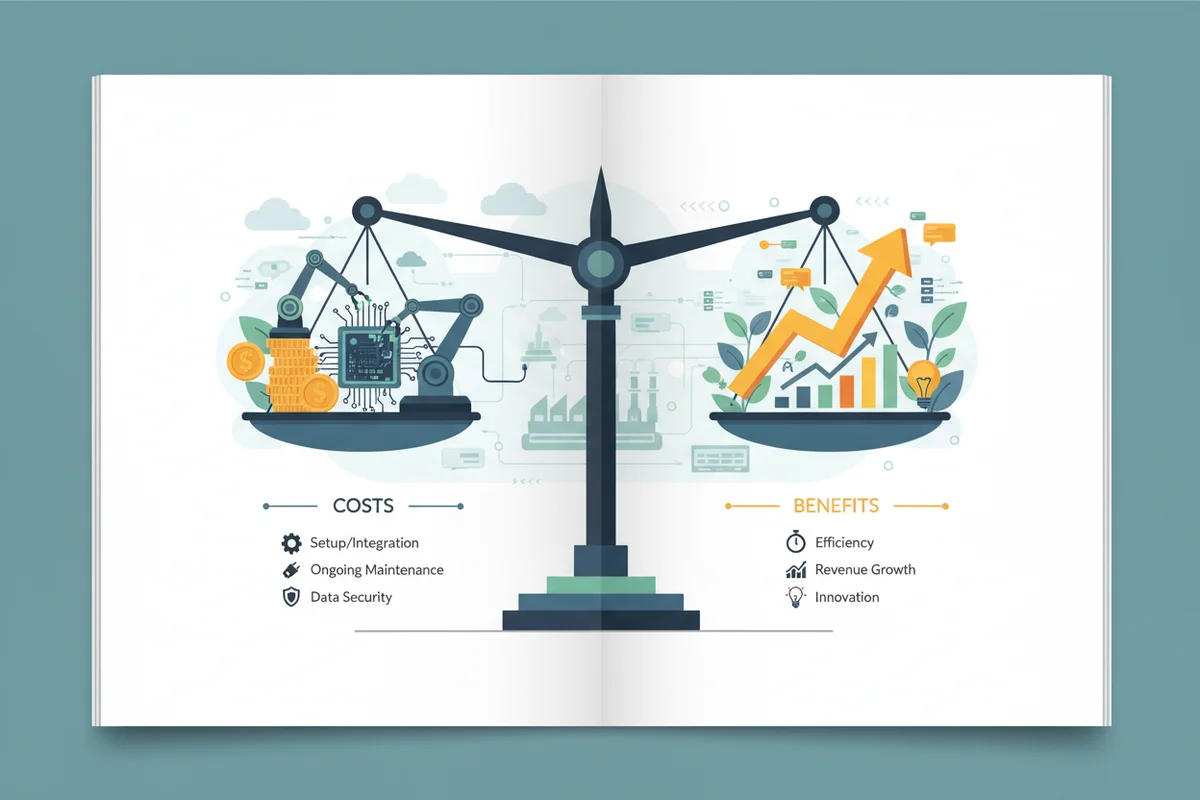
Explore the practical cost-benefit analysis of AI investments, detailing setup costs, ongoing expenses, and potential returns for businesses.
The Business Case for AI: A Practical Cost-Benefit Analysis
Artificial intelligence has moved from a speculative technology into a core business tool faster than most analysts predicted. According to McKinsey's 2025 State of AI report, 88% of organizations now use AI in at least one business function. For decision-makers weighing whether to invest, the central question is not whether AI is widely adopted but whether it will deliver measurable value for their specific operation. This analysis breaks down the real costs, realistic returns, and the conditions that separate successful implementations from expensive failures.
What You Will Spend: Initial Setup Costs
The first category of costs covers everything required before your AI system processes a single transaction or generates a single insight.
Infrastructure is typically the largest upfront expense. Depending on the complexity of your use case, this means either purchasing dedicated hardware such as GPU servers (graphics processing units, which are chips optimised for the parallel computations AI models require), subscribing to cloud-based AI services, or a combination of both. Cloud providers such as AWS, Google Cloud, and Microsoft Azure offer pay-as-you-go access to AI infrastructure, which lowers the barrier to entry but introduces ongoing variable costs that can scale quickly.
Software and licensing add another layer. Off-the-shelf AI tools carry subscription fees, while custom-built solutions require significant development investment. Integration with your existing systems, whether that is a CRM, ERP, or data warehouse, often demands specialist engineering work that is easy to underestimate in early budgets.
Talent and training represent a cost that many businesses overlook at the planning stage. Hiring data scientists, machine learning engineers, or AI product managers commands premium salaries in a competitive market. Even if you use third-party tools, your existing staff will need training to use them effectively and to interpret outputs responsibly.
A structured framework published by Alice Labs suggests that for enterprise-scale projects, these upfront costs are substantial enough that most implementations do not break even until 14 to 24 months after deployment.
What You Will Keep Spending: Ongoing Operational Expenses
AI is not a one-time purchase. Ongoing costs include model maintenance and retraining, data storage and management, security and compliance monitoring, and the human oversight required to ensure outputs remain accurate and appropriate.
Data quality is a recurring operational challenge. AI systems are only as reliable as the data they are trained on, and maintaining clean, current, and well-structured data requires dedicated resources. As your business changes, models may need to be retrained to reflect new products, customer behaviours, or market conditions.
Regulatory compliance is an emerging cost category. Governments in the EU, UK, and increasingly the US are introducing AI governance requirements. Businesses operating in regulated industries such as finance, healthcare, or insurance face additional obligations around explainability, bias auditing, and record-keeping.
What You Could Gain: Returns on Investment
The financial case for AI rests on three broad categories of return.
Productivity improvements are the most consistently documented benefit. Research compiled by Fullview.io reports productivity gains ranging from 26% to 55% across various industries following AI implementation. These gains typically come from automating repetitive tasks, accelerating data analysis, and reducing the time employees spend on administrative work.
Cost reduction follows from productivity gains. Fewer hours spent on manual processes translates directly into lower labour costs per unit of output. AI-driven quality control, predictive maintenance in manufacturing, and automated customer service routing have each demonstrated measurable cost savings in documented deployments.
Revenue growth is harder to attribute directly to AI but is reported by businesses that use it to personalise marketing, improve demand forecasting, or accelerate product development cycles.
Across these categories, Fullview.io data indicates that businesses have seen an average return of $3.70 for every dollar invested in AI. Alice Labs' framework suggests that enterprise AI projects achieving successful implementation typically deliver a three-year ROI (return on investment) of between 150% and 300%.
Where AI Has Worked and Where It Has Not
In financial services, JPMorgan Chase has publicly reported using AI to review commercial loan agreements, a task that previously required 360,000 hours of lawyer time annually and is now completed in seconds. In retail, companies using AI-driven demand forecasting have reduced inventory waste while maintaining product availability.
However, the failure rate for AI projects is high enough to warrant serious attention. Fullview.io reports that between 70% and 85% of AI projects fail to deliver expected outcomes. The most common causes are inadequate data infrastructure, unclear strategic objectives, and a mismatch between the tool selected and the actual business problem being solved.
A PwC survey cited by Tom's Hardware found that 55% of CEOs reported seeing no measurable benefits from AI deployment, and only 12% experienced both increased revenues and reduced costs simultaneously. These figures are a useful counterweight to optimistic projections and suggest that the average return figures mask a wide distribution of outcomes.
Risks and Challenges Worth Naming
Beyond financial risk, businesses face several practical challenges when implementing AI.
The skills gap is real. Many organisations lack the internal capability to evaluate AI vendors critically, manage model performance over time, or identify when a model is producing biased or unreliable outputs.
Workforce concerns require proactive management. AI-driven automation does displace certain job functions, and businesses that ignore this risk face morale, retention, and reputational consequences.
Ethical and regulatory exposure is growing. Using AI in hiring, lending, or customer segmentation without appropriate governance creates legal liability in an increasing number of jurisdictions.
A Gallup survey on AI use at work found that nearly half of US workers reported never using AI on the job, suggesting that even in organisations that have invested in AI tools, actual adoption by employees can be limited without deliberate change management.
Making the Decision
The data supports a measured conclusion. AI investment can deliver strong returns, but those returns are not automatic. The businesses most likely to achieve positive outcomes are those that begin with a clearly defined problem, invest in data quality before selecting tools, build internal capability to manage and interpret AI outputs, and treat implementation as an ongoing process rather than a one-time project.
For businesses evaluating specific use cases, the 14 to 24 month break-even window reported by Alice Labs is a useful planning benchmark. Projects with shorter payback periods typically involve automating well-defined, high-volume tasks where the inputs and outputs are measurable.
The organisations that have struggled most are those that invested in AI as a general capability without connecting it to specific operational goals. The technology is mature enough to deliver real value. Whether it delivers that value for your business depends far more on planning and execution than on the technology itself.