
What Is a GPU? A Beginner's Guide to Graphics Processing Units
By GPU Alpha
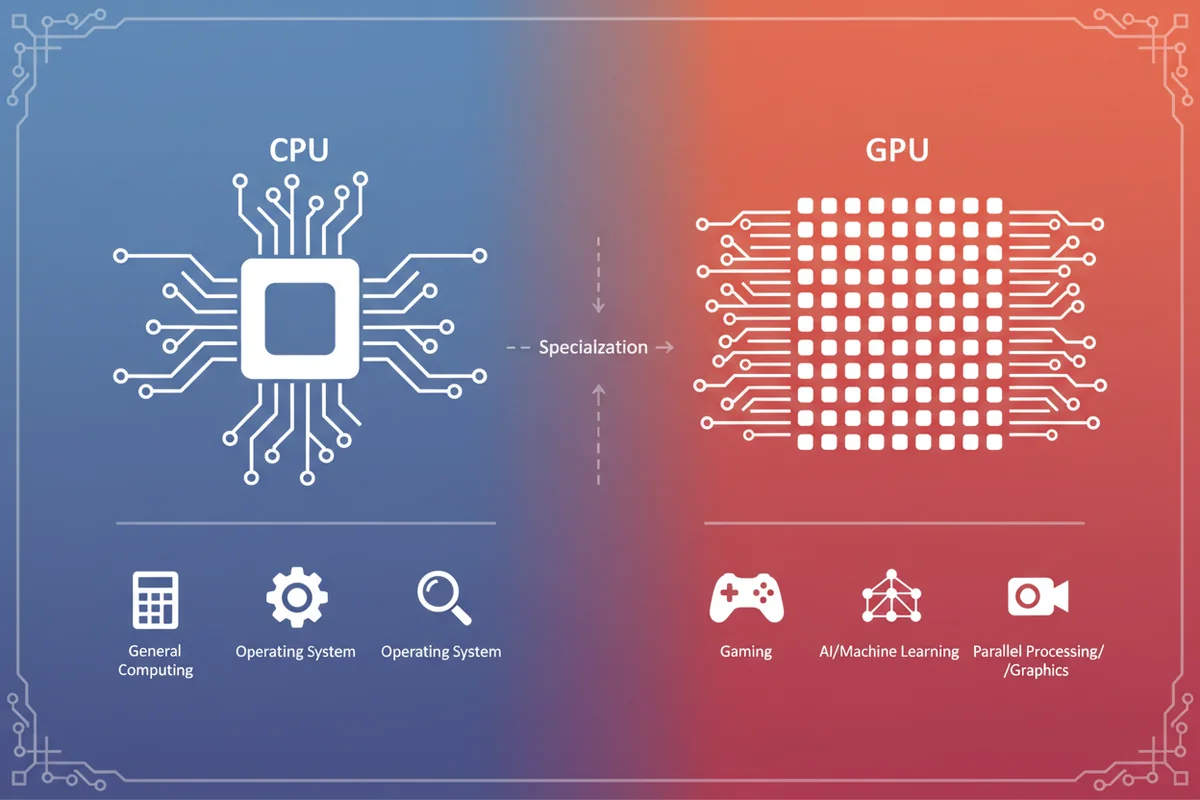
Discover the essentials of GPUs, their evolution, and why they are crucial for modern computing tasks like gaming and AI.
What Is a GPU? A Beginner's Guide to Graphics Processing Units
Graphics Processing Units, or GPUs, have quietly become one of the most important pieces of hardware in modern computing. Whether you are playing a video game, training an AI model, or analysing a large dataset, there is a good chance a GPU is doing much of the heavy lifting. Understanding what GPUs are, how they work, and why they matter is increasingly useful knowledge for anyone entering the tech space.
What Is a GPU?
A GPU is a specialised processor originally designed to render images, animations, and video. Rendering means calculating how each pixel on your screen should look, which involves enormous amounts of repetitive mathematical work. According to Codecademy, modern GPUs have evolved well beyond graphics and are now capable of handling a wide range of computational tasks, including data analysis and machine learning.
To understand what makes a GPU distinctive, it helps to compare it with a CPU, or Central Processing Unit. A CPU is the general-purpose brain of a computer. It is designed to handle tasks sequentially, meaning it works through operations one after another with great speed and flexibility. A GPU, by contrast, is built for parallel processing, which means it can perform many operations at the same time. According to IBM, CPUs excel at sequential tasks while GPUs are optimised for workloads that can be broken into many smaller tasks running simultaneously.
Think of a CPU as a small team of highly skilled specialists and a GPU as a very large team of workers each handling a simpler part of the same job. Neither is universally better. They are designed for different kinds of work.
The Evolution of GPU Technology
The GPU as a distinct product category is relatively young. NVIDIA introduced the first device officially marketed as a GPU, the GeForce 256, in 1999. According to computer.org, the GeForce 256 included hardware transform and lighting engines, which offloaded geometry calculations from the CPU for the first time. This was a meaningful shift because it meant the CPU no longer had to manage every aspect of rendering a scene.
From that starting point, GPU development has moved through several distinct eras. According to the ACM SIGGRAPH Blog, each era built on the previous one, gradually turning GPUs from fixed-function graphics chips into flexible, programmable processors capable of handling a broad range of computational tasks.
The raw numbers behind this progression are striking. According to computer.org, the transistor count in GPUs grew from 57 million in 2001 to over 92 billion in 2025. Transistors are the fundamental switching components inside a chip, and more transistors generally means more processing capability. Over the same period, the number of shaders, which are small programs that calculate how light and colour appear on surfaces, grew from 16 in 2007 to over 21,000 in 2025. These figures reflect how dramatically the underlying hardware has scaled.
Parallel Processing and Why It Matters
Parallel processing is the defining characteristic of GPU architecture. Where a CPU might have between 8 and 64 cores handling tasks in sequence or in small groups, a modern GPU can contain thousands of smaller cores all working at the same time. Each individual GPU core is less powerful than a CPU core, but the sheer number of them working together makes GPUs extremely efficient for certain types of work.
According to IBM, this parallel architecture is particularly valuable in machine learning, where training a model involves processing vast amounts of data through repeated mathematical operations. Those operations can be split across thousands of GPU cores simultaneously, reducing the time required from days to hours in many practical scenarios.
The benefit is not limited to machine learning. Any task that involves large volumes of similar calculations, whether that is simulating physics, processing financial data, or rendering video, can take advantage of parallel processing.
Common Applications of GPUs
Gaming remains the most widely recognised use case for GPUs. Rendering a modern game in real time requires calculating lighting, shadows, textures, and geometry for millions of pixels many times per second. GPUs were purpose-built for exactly this kind of workload and continue to be the primary hardware driving advances in visual fidelity in games.
Data analysis is a growing area where GPUs add significant value. Organisations working with large datasets, whether in finance, logistics, or scientific research, can use GPUs to accelerate processing tasks that would take much longer on CPU-only systems. Faster analysis means faster decisions, which has practical commercial value.
Machine learning is arguably the area where GPU capabilities have had the most transformative impact in recent years. Training a machine learning model, which means adjusting millions or billions of numerical parameters based on example data, is a highly parallelisable task. According to IBM, GPUs outperform CPUs in these workloads due to their parallel processing capabilities, making them the standard hardware choice for AI research and development.
Considerations and Trade-offs
GPUs are not without limitations, and it is worth being clear-eyed about the trade-offs involved.
Cost and accessibility are real barriers. GPUs, particularly those designed for compute workloads rather than consumer gaming, carry significant price tags. According to IBM, programming GPUs also requires specialised knowledge. Developers typically use frameworks such as CUDA, which is NVIDIA's parallel computing platform, to write software that runs efficiently on GPU hardware. This adds a layer of technical complexity that is not present when writing standard CPU-based software.
Energy consumption is another practical consideration. GPUs draw considerably more power than CPUs, which has implications for electricity costs and cooling requirements. For organisations running large numbers of GPUs in data centres, energy consumption is a meaningful operational expense and an increasingly important factor in sustainability planning.
These are not reasons to avoid GPUs, but they are factors worth understanding before committing to a GPU-based approach for any project.
Conclusion
GPUs have come a long way from their origins as dedicated graphics chips. Starting with the GeForce 256 in 1999 and progressing through decades of architectural development, they have become essential tools for gaming, data analysis, and machine learning. Their ability to perform thousands of operations simultaneously makes them well suited to the kinds of large-scale, repetitive computational tasks that define modern data-intensive work.
For anyone starting to explore the GPU landscape, whether for a personal project, a professional application, or simply to understand the technology better, the core concepts are straightforward. GPUs are parallel processors that complement CPUs rather than replace them. They are powerful, increasingly versatile, and central to some of the most significant developments in computing today.
As transistor counts continue to climb and new architectures emerge, the capabilities of GPUs will keep expanding. Understanding the fundamentals now puts you in a good position to make informed decisions about when and how to use them.