
The Economics of Sustainable AI Compute: What Business Leaders Need to Know
By GPU Alpha
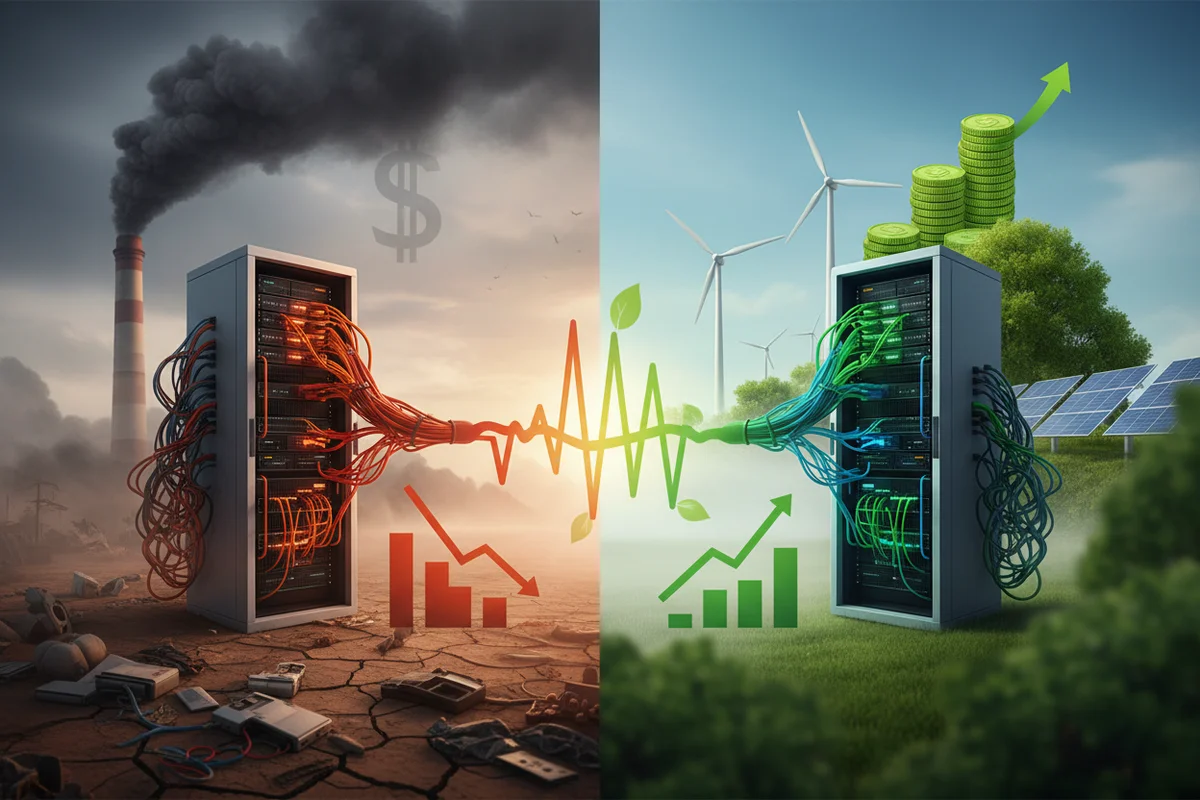
Explore the financial and environmental implications of sustainable AI compute for business leaders navigating the evolving landscape of AI infrastructure.
The Economics of Sustainable AI Compute: What Business Leaders Need to Know
Artificial intelligence has moved from experimental technology to a core business tool with remarkable speed. As organisations scale their AI deployments, the infrastructure supporting those workloads — primarily data centres packed with high-performance GPUs — is consuming energy at a rate that carries both environmental and financial consequences that business leaders can no longer afford to overlook.
The question is no longer simply whether sustainable AI compute is the right thing to do. Increasingly, the data suggests it may also be the financially rational thing to do.
The Scale of the Problem
To understand the economics, you first need to understand the scale. In 2025, data centres in the United States consumed approximately 250 terawatt-hours (TWh) of electricity, representing roughly 5 to 6 percent of the nation's total electricity generation, according to research published by the National Bureau of Economic Research (NBER). That same research estimated the environmental damages from associated air pollution and greenhouse gas emissions at approximately $25 billion in that year alone.
These are not abstract figures. They represent real costs — costs that are partially externalised today but are increasingly being internalised through regulation, carbon pricing mechanisms, and corporate sustainability commitments.
The trajectory is also worth examining carefully. Research from Goldman Sachs, cited by TechTarget, projects that U.S. data centre power demand will more than double, rising from 31 gigawatts in 2025 to 66 gigawatts by 2027. The primary driver of that increase is AI infrastructure buildout. For organisations planning multi-year AI strategies, this projected demand surge has direct implications for energy costs, infrastructure investment, and regulatory exposure.
Where the Money Goes: Cooling as a Case Study
One of the most instructive places to examine the economics of AI compute sustainability is cooling. According to an April 2026 analysis from the International Energy Agency, cited by TechTarget, cooling systems account for up to 30 percent of total data centre energy consumption. That is a substantial portion of the operational cost base for any organisation running significant AI workloads.
The technology currently used to manage that cooling load matters enormously. Traditional air-cooling methods capture only around 30 percent of the heat generated by servers, according to TechRadar. The remaining heat is effectively wasted energy — energy that was paid for but did not contribute to useful computation.
Advanced alternatives, specifically direct-to-chip liquid cooling and immersion cooling (where servers are submerged in a thermally conductive but electrically non-conductive liquid), can capture 100 percent of server-generated heat, according to the same TechRadar analysis. That improvement in thermal capture translates directly into lower energy consumption per unit of compute, reduced carbon emissions, and measurable operational cost savings over time.
The upfront capital cost of transitioning to advanced cooling infrastructure is real and should not be minimised. Retrofitting an existing data centre or specifying liquid cooling in a new build requires meaningful investment. However, for organisations running GPU-intensive AI workloads continuously, the long-run reduction in energy expenditure can offset that initial outlay.
The Broader Cost Picture for AI Deployments
Cooling is one component of a larger economic picture. Research cited by TechRadar found that UK businesses are spending an average of £321,000 on AI implementation. Despite that level of investment, only 13 percent of companies are seeing enterprise-wide impact from their generative AI deployments.
This gap between investment and measurable return is relevant to the sustainability conversation in a specific way. Organisations that are spending heavily on AI without achieving broad organisational impact are, by definition, running energy-intensive infrastructure at a lower return on investment than they could be. Improving the efficiency of AI workloads — through better model selection, smarter inference scheduling, and more efficient hardware — simultaneously reduces energy consumption and improves the financial return on AI investment.
Efficiency and sustainability, in this context, point in the same direction.
Edge Computing as a Complementary Strategy
One approach gaining traction among organisations looking to reduce the energy footprint of AI is edge inference. Edge inference refers to running AI model computations on devices or servers located closer to where data is generated, rather than routing everything through centralised cloud data centres.
TechTarget notes that edge computing can reduce the volume of data that needs to be transmitted to and processed in large centralised facilities, which in turn reduces the energy demand placed on those facilities. For applications where low latency is important — manufacturing quality control, retail analytics, or on-device AI assistants — edge inference can also deliver better performance alongside the energy benefits.
The economics of edge inference depend heavily on the specific use case, the volume of inference requests, and the cost of the edge hardware. It is not a universal solution, but for organisations with distributed operations and high-frequency inference needs, it represents a credible path to both cost reduction and lower environmental impact.
Challenges That Deserve Honest Acknowledgement
A balanced assessment of sustainable AI compute has to acknowledge the genuine challenges involved. The upfront costs of energy-efficient hardware and advanced cooling infrastructure are not trivial, particularly for smaller organisations operating with constrained capital budgets.
The complexity of implementation is also a real consideration. Transitioning from conventional air-cooled infrastructure to liquid cooling, or redesigning workload distribution to incorporate edge nodes, involves changes to existing systems, staff training, and compatibility testing. These transitions take time and carry execution risk.
There is also the question of performance trade-offs. In some configurations, energy-efficient hardware may deliver lower raw throughput than the highest-performance alternatives. For organisations running time-sensitive AI workloads, that trade-off requires careful evaluation rather than assumption.
None of these challenges make sustainable AI compute impractical. They do mean that the transition requires deliberate planning rather than reactive decision-making.
Strategies for Finding the Balance
For business leaders and technology decision-makers working through these trade-offs, a few principles are worth keeping in mind.
Start with measurement. Understanding the actual energy consumption of your current AI infrastructure — at the workload level, not just the facility level — is the foundation for any meaningful improvement. You cannot manage what you cannot measure.
Evaluate the total cost of ownership rather than the purchase price of hardware. A GPU or cooling system that costs more upfront but delivers lower energy costs over a three to five year operational period may be the more economical choice when the full financial picture is considered.
Consider workload architecture alongside hardware choices. Running smaller, more efficient models where task requirements allow, batching inference requests intelligently, and scheduling non-urgent compute during periods of lower energy cost or higher renewable availability are operational decisions that can reduce both cost and environmental impact without requiring capital investment.
Treat sustainability requirements as a planning input rather than an afterthought. Organisations that are building AI infrastructure today will be operating it for years. The regulatory and cost environment around energy consumption is moving in one direction. Building flexibility and efficiency into infrastructure decisions now reduces the risk of costly retrofits later.
The Long View
The $25 billion in estimated environmental damages from U.S. data centre operations in 2025, as documented by NBER, represents a cost that is currently distributed across society rather than fully reflected in energy bills. As carbon pricing, emissions regulations, and corporate disclosure requirements evolve, a greater share of that cost is likely to be internalised by the organisations generating it.
For business leaders who are thinking in multi-year horizons, the economics of sustainable AI compute are becoming clearer. The organisations that invest in efficient infrastructure, advanced cooling, and thoughtful workload design today are building a cost structure that will be more resilient as energy prices and regulatory requirements evolve.
Sustainability in AI compute is not a trade-off against financial performance. Approached with rigour and a long enough time horizon, it is increasingly a component of it.