
The Financial Reality of AI Datacenters: Costs, Energy, and the Path to Profitability
By GPU Alpha
Explore the financial dynamics of AI datacenters, including costs, energy consumption, and strategies for achieving profitability in this evolving
The Financial Reality of AI Datacenters: Costs, Energy, and the Path to Profitability
Artificial intelligence datacenters have become some of the most capital-intensive infrastructure projects in modern technology. As demand for AI compute grows, understanding the financial dynamics behind these facilities has become essential for investors, analysts, and technology leaders. This article breaks down the cost structures, energy economics, and sustainability trade-offs that define whether an AI datacenter succeeds or struggles financially.
What It Actually Costs to Build and Run an AI Datacenter
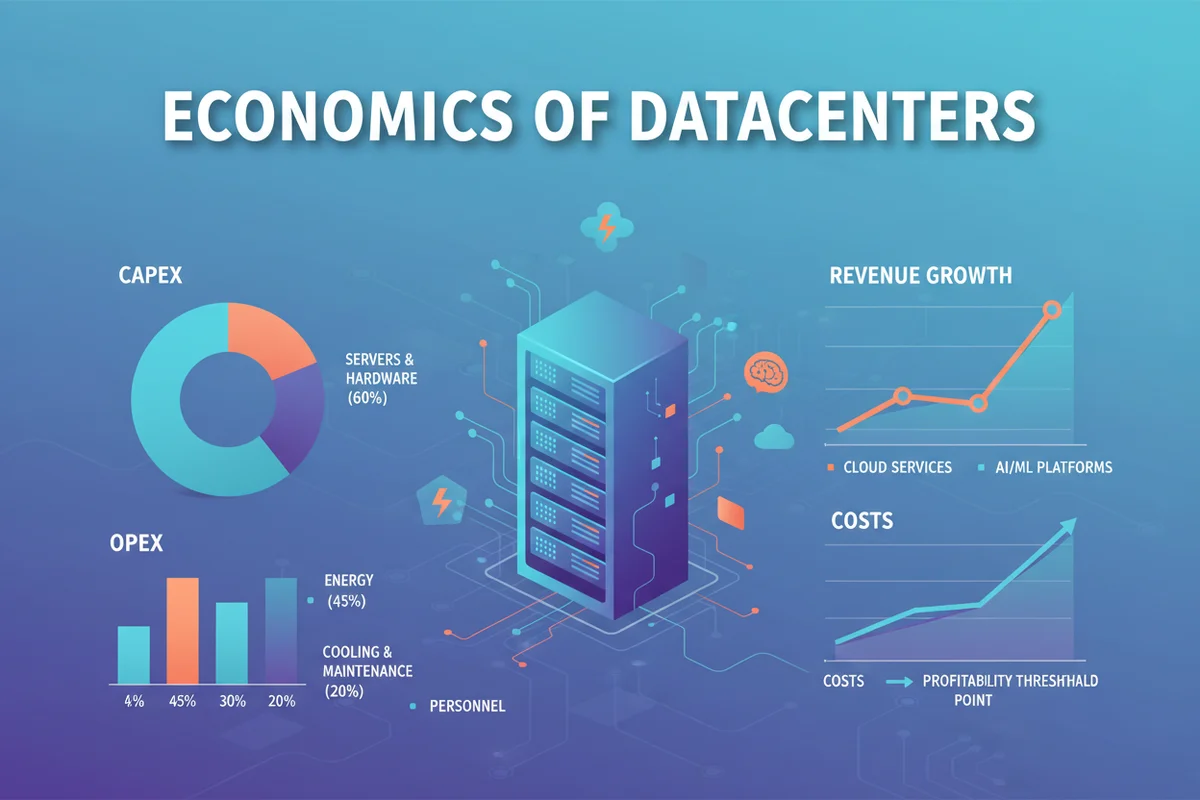
The numbers involved in AI datacenter construction are significant by any measure. According to analysis published by Epoch AI, a one-gigawatt AI datacenter requires an upfront capital expenditure of approximately $38 billion, with annual operating expenses running at around $0.9 billion on top of that.
Capital expenditure, often called CapEx, refers to the large one-time investment required to build and equip the facility. Operating expenses, or OpEx, are the ongoing costs to keep the facility running year after year. Both figures matter when evaluating the long-term financial viability of a datacenter project.
Within that total cost picture, hardware dominates. Epoch AI's data shows that servers account for approximately 60% of the total cost of ownership for AI datacenters. This reflects the enormous expense of the specialised processors, memory systems, and networking equipment required to run large-scale AI workloads. When a single high-performance AI server can cost tens of thousands of dollars, and a large facility requires thousands of them, the hardware bill accumulates quickly.
The remaining costs are distributed across physical infrastructure such as buildings and power delivery systems, cooling equipment, networking, and ongoing staffing. Each of these categories carries its own financial profile, but none approaches the scale of the server hardware investment.
Energy Consumption and Its Direct Effect on Profitability
Energy is the most significant ongoing operational cost in an AI datacenter, and the trajectory of consumption is moving sharply upward. According to S&P Global Market Intelligence, AI datacenters are projected to consume nearly 800 terawatt-hours of electricity by 2030, which is more than double the levels recorded in 2024. A terawatt-hour is one trillion watt-hours, a unit that helps illustrate the scale of electricity involved.
The International Energy Agency offers a slightly broader view, projecting that global electricity consumption by datacenters will almost double to 945 terawatt-hours per year by 2030, representing approximately 3% of total global electricity generation, according to research published in Mineral Economics via Springer Nature.
For datacenter operators, electricity costs translate directly into margin pressure. Energy is typically priced per kilowatt-hour, and when a facility draws power at gigawatt scale around the clock, even small movements in electricity prices have a material impact on profitability. Operators in regions with lower electricity costs, or those with access to long-term power purchase agreements at fixed rates, hold a meaningful financial advantage over competitors paying spot market prices.
This energy dynamic also shapes where datacenters are built. Locations with access to cheap hydroelectric power, favorable climates that reduce cooling loads, or proximity to renewable energy sources are increasingly attractive from a financial planning perspective.
Cooling Technology as a Financial and Operational Variable
Cooling is one of the less visible but financially important components of datacenter operations. Traditional air cooling systems require substantial energy to run and, in many cases, large volumes of water to function effectively. As AI hardware has become more power-dense, meaning more computing power packed into smaller physical spaces, the heat generated per square foot has increased significantly.
NVIDIA has developed a warm liquid cooling system for its next-generation AI infrastructure that addresses both the energy and water dimensions of this problem. According to reporting by Windows Central and Tom's Guide, this system operates effectively at temperatures up to 113 degrees Fahrenheit and can reduce cooling-related water consumption from approximately 2.6 million gallons per megawatt annually to nearly zero in favorable climates.
That reduction in water usage carries direct financial implications. Water costs money, and in some regions it is a constrained resource that comes with regulatory and reputational risks. Oracle's Project Jupiter datacenter in New Mexico drew public attention over its water usage in a desert region, as reported by Tom's Hardware, illustrating how water consumption can become both a financial liability and a public relations challenge.
From a pure cost perspective, liquid cooling systems that reduce water dependency also tend to improve power usage effectiveness, which is a standard industry metric measuring how efficiently a facility uses the electricity it draws. A lower power usage effectiveness score means more of the electricity consumed goes toward actual computing rather than cooling overhead, which improves the economics of every workload run in the facility.
How Operators Generate Revenue from These Assets
The capital and operating costs described above must be offset by revenue, and AI datacenters generate income through several distinct models.
Hyperscale cloud providers such as Microsoft, Google, and Amazon build and operate datacenters primarily to support their own AI services and to sell compute capacity to external customers. Revenue comes from cloud service contracts, API access fees for AI models, and long-term enterprise agreements. These operators benefit from scale, spreading fixed costs across enormous customer bases.
Colocation operators take a different approach, leasing physical space, power, and cooling infrastructure to customers who bring their own servers. Revenue is typically tied to power capacity reserved rather than compute cycles consumed. As demand for AI compute has grown, colocation pricing in key markets has risen accordingly.
A third model involves purpose-built AI inference facilities, where operators run specific AI models as a service and charge per query or per hour of compute time. This model is more directly tied to AI workload demand and can generate strong margins when utilisation rates are high.
Across all models, utilisation rate is a critical financial variable. A datacenter running at 90% utilisation generates substantially better returns on its fixed capital base than one running at 50%, making demand forecasting and customer acquisition central to financial performance.
The Sustainability Challenge and Its Financial Consequences
The environmental footprint of AI datacenters is not simply a reputational concern. It carries tangible financial consequences that operators must account for in their planning.
Consumer Reports has noted that the rapid expansion of AI datacenters has raised concerns about increased energy demand and water usage, and these concerns are increasingly reflected in regulatory environments and community relations. Facilities that consume large amounts of water in water-stressed regions face potential restrictions, higher costs, and opposition from local communities.
The Oracle Project Jupiter situation in New Mexico, where the company described an 11-million-gallon one-time water fill as negligible, illustrates the gap that can exist between operator assessments and community perceptions. That gap creates regulatory and reputational risk, both of which have financial value.
On the energy side, companies that fail to meet sustainability commitments face growing pressure from institutional investors and corporate customers who have their own emissions targets to meet. This is pushing operators toward renewable energy procurement, more efficient cooling, and hardware refresh cycles that prioritise energy efficiency alongside raw performance.
Microsoft has reported progress on reducing water consumption in its AI-era datacenters, as noted by Axios, suggesting that the industry is making measurable progress. However, the absolute scale of energy consumption continues to grow as AI workloads expand, meaning efficiency gains must outpace volume growth to produce a net environmental improvement.
What the Financial Picture Tells Us
AI datacenters represent a high-stakes capital allocation decision. The upfront investment is substantial, the ongoing energy costs are significant and growing, and the competitive dynamics reward operators who can manage both hardware costs and energy efficiency effectively.
The 60% share of total costs attributable to servers, as documented by Epoch AI, means that hardware procurement strategy is central to financial performance. Operators who can access the right hardware at competitive prices, manage refresh cycles efficiently, and maximise utilisation rates will be better positioned than those who cannot.
Energy and cooling costs are the second major financial lever. Innovations like NVIDIA's warm liquid cooling system represent genuine progress, but the projected doubling of datacenter electricity consumption by 2030 means that energy management will remain a defining challenge for the industry throughout this decade.
For analysts evaluating companies in this space, the key metrics to watch are capital expenditure commitments, power usage effectiveness ratios, utilisation rates, and the geographic distribution of facilities relative to energy costs and regulatory environments. These factors, taken together, provide a clearer picture of long-term profitability than headline revenue figures alone.