
How AI Is Reshaping Economic Growth: What Policymakers and Business Strategists Need to Know
By GPU Alpha
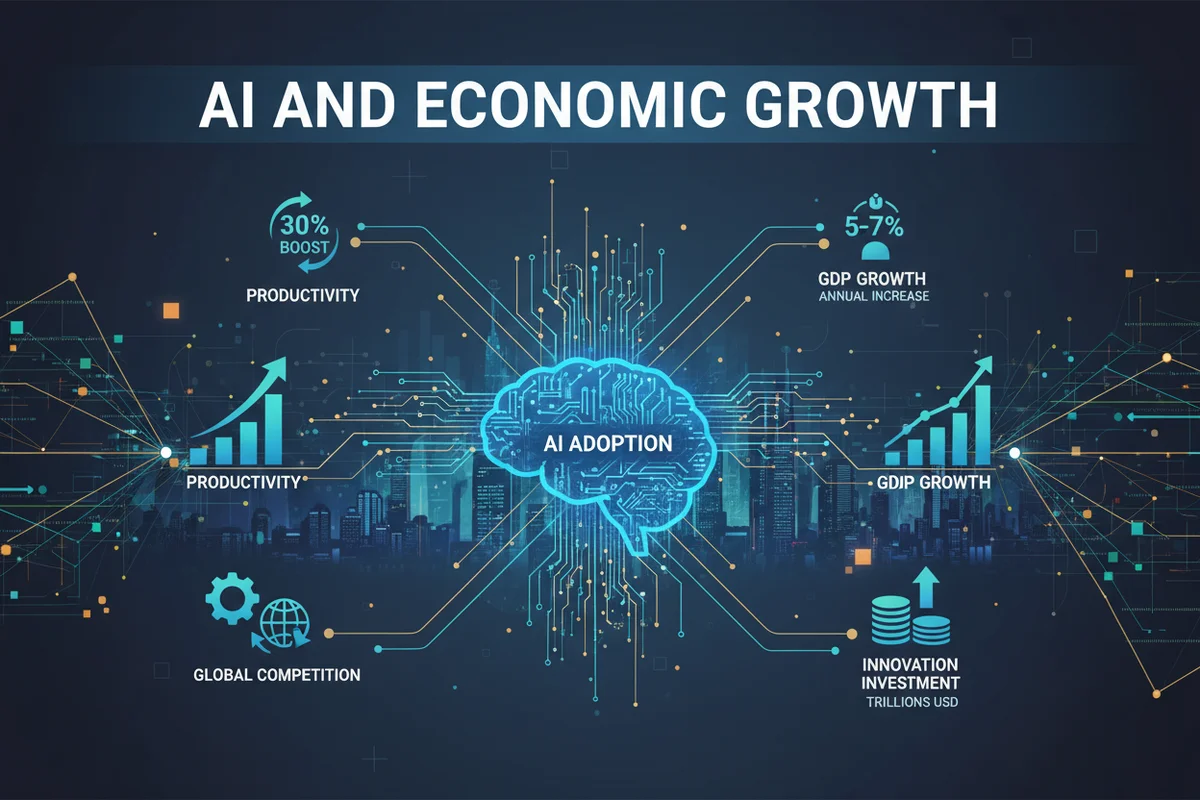
AI is transforming economic growth, influencing competition and productivity. Policymakers must understand its profound impact on the economy.
How AI Is Reshaping Economic Growth: What Policymakers and Business Strategists Need to Know
Artificial intelligence is moving from a niche technology into a foundational driver of economic activity. Across sectors ranging from finance to education, AI is influencing how work gets done, how businesses compete, and how economies grow. For policymakers and business strategists, understanding the scale and mechanics of this shift is no longer optional. The data now available makes a compelling case that AI is not simply a productivity tool but a structural force reshaping the economic landscape.
AI as a General-Purpose Technology
Economists use the term General-Purpose Technology, or GPT, to describe innovations that are broad enough in application to transform entire economies over time. Historical examples include electricity and the internet. The OECD's 2024 analysis of AI's economic impact classifies artificial intelligence as a GPT, noting that its capacity for autonomy and self-improvement sets it apart from earlier waves of automation (OECD, 2024).
What makes AI distinctive as a GPT is that it does not simply execute predefined tasks. It can identify patterns, generate novel outputs, and improve its own performance over time with additional data. This means AI can accelerate the pace of innovation itself, not just the pace of production. For policymakers, this distinction matters because the economic effects of a GPT unfold over decades and tend to be uneven in their early stages before becoming broadly distributed.
The OECD notes that AI has the potential to revive sluggish productivity growth that has persisted across many advanced economies since the 2008 financial crisis. Whether that potential is realised depends heavily on how governments and businesses choose to deploy and regulate the technology.
Quantifying AI's Contribution to Productivity
The productivity numbers now emerging from economic research are significant. According to research published by the American Economic Association, AI and software products contributed to 50 percent of the 2 percent average growth rate in nonfarm business labor productivity in the United States between 2017 and 2024 (AEA, 2025). The same research found that AI and software accounted for 50 percent of the 1.2 percentage point acceleration in productivity growth compared to the 2012 to 2017 period.
To put that in plain terms: roughly half of the measurable improvement in how efficiently American workers produce output over the past seven years can be attributed to AI and related software. This is a striking finding for strategists who have been uncertain whether AI investment translates into real economic output.
Labor productivity, defined as the value of goods and services produced per hour of work, is one of the most important long-run drivers of living standards and corporate profitability. When productivity grows, businesses can pay higher wages, generate more profit, and invest in further innovation without simply raising prices. A sustained contribution of this scale from a single category of technology is historically unusual and warrants serious attention from both business leaders and government planners.
The Economic Potential of Generative AI
Generative AI, the category of AI that produces text, images, code, and other content in response to prompts, represents a newer and potentially larger wave of economic impact. McKinsey's analysis of 63 specific use cases found that generative AI has the potential to add between $2.6 trillion and $4.4 trillion annually to the global economy (McKinsey, 2023). That figure represents a 15 to 40 percent increase on top of the estimated economic impact of all AI technologies combined.
The sectors with the highest potential value identified in the McKinsey analysis include customer operations, marketing and sales, software engineering, and research and development. In customer operations, for example, generative AI can handle routine queries, draft responses, and summarise case histories, freeing human agents to focus on complex or high-value interactions. In software engineering, AI coding assistants can accelerate development cycles and reduce the cost of building and maintaining software products.
For business strategists, the McKinsey range of $2.6 trillion to $4.4 trillion is not a prediction but an estimate of addressable value across use cases that are technically feasible today. Capturing that value requires deliberate investment in infrastructure, workforce training, and process redesign. The gap between potential and realised value will be determined largely by execution quality at the firm and sector level.
Workforce Adoption and Employee Sentiment
The rate at which workers are actually using AI tools is an important leading indicator of whether productivity gains will materialise at scale. Gallup survey data reported in Q1 2026 found that 50 percent of U.S. employees reported using AI in their roles, with 13 percent using it daily and 28 percent using it daily or weekly (Gallup via Tom's Hardware, 2026). The same survey found that 65 percent of employees felt positive about AI's impact on their productivity.
Crossing the 50 percent adoption threshold is a meaningful milestone. Technology adoption research consistently shows that once a tool reaches majority adoption in a workforce, network effects and shared knowledge begin to compound its value. Employees learn from each other, workflows get redesigned around the tool's capabilities, and the marginal cost of adoption for remaining users falls.
The 65 percent positive sentiment figure is also relevant for policymakers concerned about workforce resistance to AI. While concerns about job displacement are legitimate and require policy responses, the data suggests that a majority of workers who are actively using AI tools view them as helpful rather than threatening. This creates a more constructive environment for managed transitions than some earlier forecasts anticipated.
Regional and Sectoral Dimensions
AI's economic impact is not uniform across geographies or industries. The OECD's 2024 report on job creation and local economic development highlights that generative AI is expected to have a significant impact on regions that were previously less exposed to automation (OECD, 2024). Sectors identified as particularly affected include education, information and communications technology, and finance.
This finding has important implications for regional economic policy. Earlier waves of automation primarily affected manufacturing-heavy regions. Generative AI, by contrast, is more likely to affect knowledge-work-intensive regions and sectors. Cities and regions that built their economic base on financial services, professional services, or public sector employment may face more significant labour market adjustments than they experienced during previous automation cycles.
For business strategists operating across multiple geographies, this means that workforce planning and AI deployment strategies may need to be calibrated differently by location. A financial services firm with operations in both a major metropolitan centre and a smaller regional hub may find that AI adoption affects those workforces in different ways and at different speeds.
Counterpoints and Risks That Strategists Should Not Ignore
The case for AI-driven economic growth is supported by meaningful data, but it is not without credible counterarguments. A survey of approximately 6,000 executives conducted by the National Bureau of Economic Research found that over 80 percent reported no notable impact on productivity from AI, and more than 90 percent reported no change in employment due to the technology (The Week, citing NBER research). This gap between aggregate data and firm-level experience is a known feature of GPT adoption cycles, where benefits often take years to appear in company-level metrics.
Research published in Le Monde by economist Patrick Artus notes that AI is expected to affect 35 to 50 percent of tasks across the economy, with the risk of displacing mid-skilled workers, particularly younger ones (Le Monde, 2026). Artus argues that AI's impact on growth will depend significantly on whether redistribution policies are designed to ensure that productivity gains are shared broadly rather than concentrated among capital owners.
There is also the question of energy consumption. Research published on arXiv highlights that AI infrastructure is highly energy-intensive, and that monitoring the relationship between energy use and economic productivity will be necessary to assess whether AI-driven growth is sustainable over the long term (arXiv, 2025). For policymakers developing AI strategies, energy infrastructure and sustainability frameworks are not peripheral concerns but central ones.
What This Means for Policymakers and Strategists
The evidence reviewed here points to several practical conclusions. First, AI's contribution to productivity growth is already measurable and material, accounting for roughly half of U.S. labor productivity growth over the past seven years according to AEA research. Second, the potential scale of generative AI's economic contribution, estimated at up to $4.4 trillion annually by McKinsey, is large enough to justify significant investment in deployment infrastructure and workforce capability. Third, adoption is accelerating, with half of U.S. employees now using AI tools, but realising the full economic benefit requires deliberate management of the transition.
For policymakers, the priorities that follow from this evidence include investing in AI literacy and reskilling programmes, particularly for mid-skilled workers in sectors facing high task displacement. Regional economic strategies should account for the fact that generative AI affects knowledge-work sectors differently from earlier automation waves. Energy policy and AI infrastructure planning need to be developed in parallel rather than in separate silos.
For business strategists, the data supports a clear-eyed investment case for AI adoption, while also highlighting that firm-level productivity gains are not automatic. The gap between aggregate economic impact and individual company results suggests that execution, change management, and workflow redesign are as important as the technology itself.
AI's role in economic growth is no longer speculative. The data is accumulating, the adoption curves are steepening, and the policy and strategic choices made in the next few years will determine how broadly and equitably those gains are distributed.